Oct 4, 1957, 19:28 – Sep 24, 2026·91 events
The Race to the Moon
All 91 events
In date order. Indented events happen within the event above them. Times are shown in UTC. Last updated September 24, 2026.
· Soviet Union and Russia
Sputnik 1: the first artificial satellite
A 58 cm metal sphere with four antennas is launched from Baikonur. Its radio beeps can be heard by amateurs around the world, and the Space Age begins.
Sources: Wikipedia: Sputnik 1
· Soviet Union and Russia
Sputnik 2 carries Laika
The dog Laika becomes the first animal to orbit Earth. She dies within hours from overheating; the spacecraft was never designed to return.
Sources: Wikipedia: Sputnik 2; Wikipedia: Laika
1958 – 1963 · United States
Project Mercury
The first US human spaceflight programme: can a person survive in space, and come home? Zoom in for its flights.
Sources: Wikipedia: Project Mercury
· United States
Alan Shepard: first American in space
Freedom 7 flies a 15-minute suborbital arc into space and back, splashing down in the Atlantic.
Sources: Wikipedia: Mercury-Redstone 3
· United States
John Glenn orbits Earth
Aboard Friendship 7, Glenn becomes the first American to orbit Earth, circling it three times.
Sources: Wikipedia: Mercury-Atlas 6
· United States
Faith 7: the last Mercury flight
Gordon Cooper spends more than a day in orbit and flies the capsule home by hand after its electrical systems fail.
Sources: Wikipedia: Mercury-Atlas 9
· United States
Explorer 1: the first US satellite
Four months after Sputnik, the US reaches orbit. James Van Allen’s instrument aboard discovers the radiation belts around Earth that now bear his name.
Sources: Wikipedia: Explorer 1; Wikipedia: Van Allen radiation belt
· Politics & culture
NASA is created
President Eisenhower signs the National Aeronautics and Space Act, creating a civilian space agency in response to Sputnik.
Sources: Wikipedia: NASA; Wikipedia: National Aeronautics and Space Act
· Robotic explorers
Luna 2 hits the Moon
The Soviet probe becomes the first human-made object to reach another world, crashing into the Moon.
Sources: Wikipedia: Luna 2
· Robotic explorers
Luna 3 photographs the far side
For the first time, people see the side of the Moon that always faces away from Earth. It looks surprisingly different, with few dark “seas”.
1961 – Dec 19, 1972 · United States
The Apollo programme
The programme that landed twelve astronauts on the Moon between 1969 and 1972. Zoom in to see each mission, and keep zooming into Apollo 11.
Sources: Wikipedia: Apollo program
· United States
Apollo 1 fire
A fire during a launch-pad rehearsal kills Gus Grissom, Ed White and Roger Chaffee. The spacecraft is redesigned before anyone flies.
Sources: Wikipedia: Apollo 1
· United States
Apollo 7: back in space
The first crewed Apollo flight tests the redesigned command and service module in Earth orbit for almost eleven days.
Sources: Wikipedia: Apollo 7
· United States
Apollo 8: first humans to orbit the Moon
Frank Borman, Jim Lovell and Bill Anders become the first people to leave Earth orbit and see the far side of the Moon with their own eyes.
Sources: Wikipedia: Apollo 8
· United States
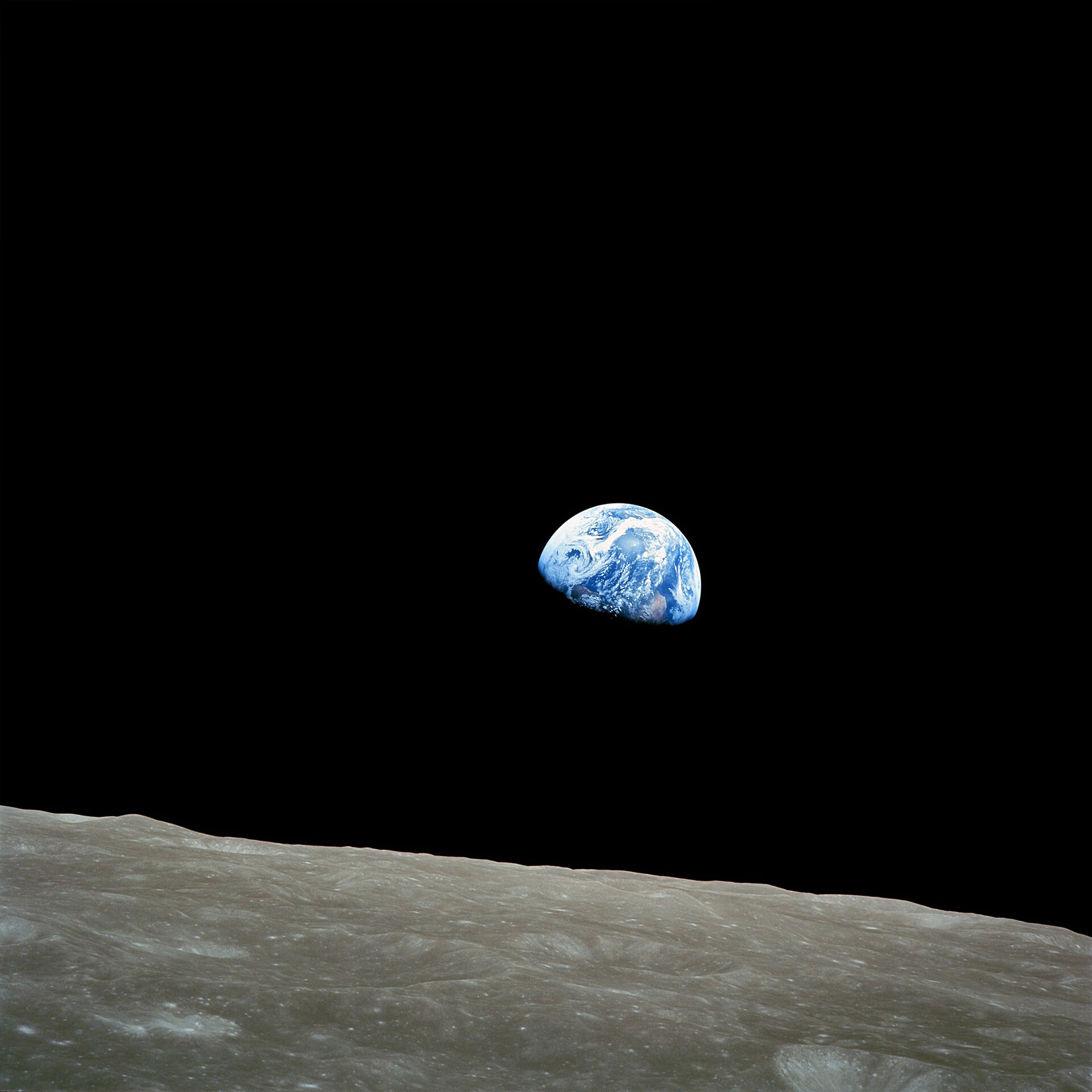
“Earthrise” is photographed
On the fourth orbit, Bill Anders photographs Earth rising over the lunar horizon: one of the most influential environmental photographs ever taken.
Sources: Wikipedia: Earthrise
· United States
Apollo 9: the lunar module flies
The lunar module is flown with a crew for the first time, in Earth orbit.
Sources: Wikipedia: Apollo 9
· United States
Apollo 10: dress rehearsal
Everything but the landing: the lunar module descends to about 15 km above the Moon’s surface.
Sources: Wikipedia: Apollo 10
· United States
Apollo 11: the first Moon landing
Neil Armstrong, Buzz Aldrin and Michael Collins fly to the Moon. Keep zooming: the mission opens into days, and the landing into minutes.
Sources: Wikipedia: Apollo 11
· United States
Lift-off from Kennedy Space Center
The Saturn V lifts off from Launch Complex 39A in Florida, watched by around a million people nearby and many millions on television.
Sources: Wikipedia: Apollo 11; Wikipedia: Saturn V
· United States
Translunar injection
The third stage fires again to push the spacecraft out of Earth orbit and onto a path to the Moon.
Sources: Wikipedia: Trans-lunar injection
· United States
Arrival in lunar orbit
Behind the Moon, out of radio contact, the service module engine fires to slow the spacecraft into lunar orbit.
Sources: Wikipedia: Apollo 11
· United States
Eagle separates from Columbia
Armstrong and Aldrin undock the lunar module Eagle. Michael Collins stays behind, orbiting alone in the command module Columbia.
· United States
Powered descent begins
Eagle’s descent engine fires for the twelve-minute descent to the surface.
Sources: Wikipedia: Apollo 11
· United States
The “1202” program alarm
The guidance computer, overloaded with work, raises alarms. Mission Control judges it safe to continue: the software, led by Margaret Hamilton’s team, drops lower-priority tasks and keeps flying.
Sources: Wikipedia: Apollo 11; Wikipedia: Apollo Guidance Computer; Wikipedia: Margaret Hamilton
· United States
“The Eagle has landed”
Armstrong steers past a boulder-strewn crater and sets Eagle down in the Sea of Tranquility with little fuel left.
· United States
Armstrong steps onto the Moon
“That’s one small step for [a] man, one giant leap for mankind.” An estimated 600 million people watch live.
Sources: Wikipedia: Apollo 11
· United States
Aldrin joins him
Buzz Aldrin climbs down about 19 minutes later and describes the view as “magnificent desolation”.
Sources: Wikipedia: Apollo 11; Wikipedia: Buzz Aldrin
· United States
Moonwalk ends
After about two and a half hours outside, collecting 21.5 kg of samples and setting up experiments, the astronauts seal the hatch.
Sources: Wikipedia: Apollo 11
· United States
Eagle lifts off from the Moon
The ascent stage fires, leaving the descent stage behind as a launch platform, and climbs back to Columbia.
Sources: Wikipedia: Apollo 11
· United States
Splashdown in the Pacific
Columbia lands in the Pacific and the crew is recovered by USS Hornet, then quarantined for 21 days in case of lunar germs.
Sources: Wikipedia: Apollo 11; Wikipedia: USS Hornet (CV-12)
· United States
Apollo 12: a pinpoint landing
Lightning strikes the rocket twice during launch. Pete Conrad and Alan Bean then land within walking distance of the Surveyor 3 probe.
Sources: Wikipedia: Apollo 12
· United States
Apollo 13: “a successful failure”
An oxygen tank explodes on the way to the Moon. The crew use the lunar module as a lifeboat and loop around the Moon to get home.
Sources: Wikipedia: Apollo 13
· United States
“Houston, we’ve had a problem”
Oxygen tank 2 in the service module explodes, crippling the spacecraft about 56 hours into the flight.
Sources: Wikipedia: Apollo 13
· United States
Apollo 14
Alan Shepard, America’s first astronaut, walks on the Moon and hits two golf balls.
Sources: Wikipedia: Apollo 14
· United States
Apollo 15: the Lunar Roving Vehicle
The first of the longer “J missions”. Astronauts drive an electric rover across the Moon, finding the ancient “Genesis Rock”.
Sources: Wikipedia: Apollo 15; Wikipedia: Lunar Roving Vehicle
· United States
Apollo 16
The first landing in the lunar highlands, at Descartes.
Sources: Wikipedia: Apollo 16
· United States
Apollo 17: the last Moon landing
Geologist Harrison Schmitt becomes the only scientist to walk on the Moon. No one has been back since.
Sources: Wikipedia: Apollo 17
· United States
“The Blue Marble” is photographed
About five hours after launch, the crew photograph the whole Earth fully lit by the Sun, one of the most reproduced images in history.
Sources: Wikipedia: The Blue Marble
· United States
The last footsteps on the Moon
Eugene Cernan climbs into the lunar module last, saying they leave “as we came and, God willing, as we shall return”.
Sources: Wikipedia: Apollo 17; Wikipedia: Eugene Cernan
· Soviet Union and Russia
Vostok programme
The first Soviet human spaceflight programme: six single-seat flights. Zoom in to see them.
Sources: Wikipedia: Vostok programme
· Soviet Union and Russia
Yuri Gagarin: first human in space
Aboard Vostok 1, Gagarin completes one orbit of Earth in 108 minutes, then ejects and parachutes to the ground near Engels.
Sources: Wikipedia: Vostok 1; Wikipedia: Yuri Gagarin
· Soviet Union and Russia
Vostok 2: a full day in orbit
Gherman Titov spends more than 25 hours in orbit and becomes the first person to sleep in space.
Sources: Wikipedia: Vostok 2
· Soviet Union and Russia
Valentina Tereshkova: first woman in space
Aboard Vostok 6, Tereshkova orbits Earth 48 times in almost three days. Another woman would not fly in space for 19 years.
Sources: Wikipedia: Vostok 6; Wikipedia: Valentina Tereshkova
· Politics & culture
Kennedy sets the goal
Six weeks after Gagarin, President Kennedy asks Congress to commit to “landing a man on the Moon and returning him safely to the Earth” before the decade is out.
Sources: Wikipedia: Apollo program
· Politics & culture
“We choose to go to the Moon”
At Rice University, Kennedy explains why: “not because they are easy, but because they are hard.”
· Robotic explorers
Ranger 7 sends close-ups
After six failed Rangers, the seventh returns more than 4,000 photographs in the minutes before it crashes into the Moon.
Sources: Wikipedia: Ranger 7
· Soviet Union and Russia
Voskhod programme
Two flights adapted from Vostok to beat the American Gemini programme to multi-person crews and spacewalks.
Sources: Wikipedia: Voskhod programme
· Soviet Union and Russia
Voskhod 1: first multi-person crew
Three cosmonauts squeeze into a capsule built for one or two, flying without spacesuits.
Sources: Wikipedia: Voskhod 1
· Soviet Union and Russia
Alexei Leonov: first spacewalk
Leonov spends about 12 minutes outside Voskhod 2. His suit balloons in the vacuum and he has to vent air to squeeze back through the airlock.
Sources: Wikipedia: Voskhod 2; Wikipedia: Alexei Leonov
· United States
Project Gemini
Ten crewed flights that practise everything a Moon landing needs: long missions, spacewalks, rendezvous and docking.
Sources: Wikipedia: Project Gemini
· United States
Ed White: first American spacewalk
During Gemini 4, White floats outside for about 23 minutes on a tether, steering with a hand-held gas gun.
Sources: Wikipedia: Gemini 4
· United States
First rendezvous in orbit
Gemini 6A pulls within about 30 cm of Gemini 7: two crewed spacecraft deliberately meet in orbit for the first time.
Sources: Wikipedia: Gemini 6A
· United States
Gemini 8: first docking
Neil Armstrong and David Scott dock with an uncrewed Agena target, then a stuck thruster sends them into a violent spin that Armstrong brings under control.
Sources: Wikipedia: Gemini 8
· United States
Gemini 12: spacewalking solved
Using footholds, handholds and underwater training, Buzz Aldrin shows that useful work outside a spacecraft is possible.
Sources: Wikipedia: Gemini 12
· Robotic explorers
Luna 9: first soft landing
The Soviet lander touches down intact and sends back the first pictures from the surface, proving the ground can support a spacecraft.
Sources: Wikipedia: Luna 9
· Robotic explorers
Surveyor 1 lands
The first American soft landing on the Moon, returning over 11,000 pictures.
Sources: Wikipedia: Surveyor 1
· Robotic explorers
First picture of Earth from the Moon
Lunar Orbiter 1, mapping possible Apollo landing sites, turns to photograph Earth over the lunar horizon.
Sources: Wikipedia: Lunar Orbiter 1
· Politics & culture
Outer Space Treaty
The US, UK and USSR sign a treaty declaring that no nation can claim the Moon or other celestial bodies, and banning nuclear weapons in space.
Sources: Wikipedia: Outer Space Treaty
· Soviet Union and Russia
Soyuz 1: Vladimir Komarov is killed
The first crewed Soyuz is plagued by failures; on re-entry its parachutes fail to open and Komarov becomes the first person to die during a spaceflight.
Sources: Wikipedia: Soyuz 1
· Robotic explorers
Zond 5: tortoises around the Moon
Two tortoises, insects and plants become the first living things to travel around the Moon and return safely to Earth.
Sources: Wikipedia: Zond 5
· Soviet Union and Russia
The N1 Moon rocket
The giant rocket meant to carry cosmonauts to the Moon. All four launches failed, and the Soviet crewed lunar programme was cancelled.
Sources: Wikipedia: N1 (rocket)
· Soviet Union and Russia
N1 explodes on the launch pad
Seconds after lift-off the second N1 falls back onto its pad, one of the largest rocket explosions in history, less than two weeks before Apollo 11 launches.
Sources: Wikipedia: N1 (rocket)
· Robotic explorers
Luna 15 crashes during Apollo 11
A Soviet robot sent to scoop up lunar soil before the Americans could crashes into the Sea of Crises while Armstrong and Aldrin are still on the surface.
Sources: Wikipedia: Luna 15
· Robotic explorers
Luna 16 returns Moon rock by robot
The first robotic sample return: 101 grams of lunar soil from the Sea of Fertility arrive in the Soviet Union.
Sources: Wikipedia: Luna 16
· Robotic explorers
Lunokhod 1: the first rover
A remote-controlled eight-wheeled rover, driven from Earth, explores the Moon for about ten months.
Sources: Wikipedia: Lunokhod 1
· Soviet Union and Russia
Salyut 1: the first space station
Having lost the Moon race, the Soviet Union turns to long-duration space stations. The Soyuz 11 crew who lived aboard die on the way home when their capsule depressurises.
Sources: Wikipedia: Salyut 1; Wikipedia: Soyuz 11
· Politics & culture
Apollo–Soyuz: a handshake in orbit
An American Apollo and a Soviet Soyuz dock in orbit, and their crews shake hands through the hatch. It is widely seen as the symbolic end of the Space Race.
Sources: Wikipedia: Apollo–Soyuz; Wikipedia: Space Race
· Politics & culture
The return to the Moon
After Luna 24 in 1976, no spacecraft landed on the Moon for 37 years. Zoom in to follow the robotic return led by China, India, Japan and private companies, and NASA's Artemis program. As of September 24, 2026.
Sources: Wikipedia: Luna 24; Wikipedia: Artemis program
· Soviet Union and Russia
Luna 24: the last landing for 37 years
The Soviet probe lands in the Sea of Crises and returns 170.1 grams of soil to Siberia four days later. No other spacecraft soft-lands on the Moon until 2013.
Sources: Wikipedia: Luna 24
· Robotic explorers
Chang'e 3: China lands on the Moon
The first soft landing on the Moon since Luna 24 in 1976 makes China the third country to land there. The lander touches down in Mare Imbrium and releases the Yutu ("Jade Rabbit") rover.
Sources: Wikipedia: Chang'e 3
· United States
Artemis program
NASA's program to return astronauts to the Moon, set in motion by Space Policy Directive 1, which President Trump signed on December 11, 2017. Zoom in to see its flights so far.
Sources: Wikipedia: Artemis program; Wikipedia: Space Policy Directive 1
· United States
The program is named Artemis
NASA Administrator Jim Bridenstine announces the name of the new lunar program. In Greek mythology, Artemis is Apollo's twin sister.
Sources: Wikipedia: Artemis program
· United States
Artemis I: Orion flies around the Moon uncrewed
The first launch of the Space Launch System sends an empty Orion capsule around the Moon. It passes about 130 km above the surface and reaches 268,563 miles from Earth before splashing down off Baja California after 25 days.
Sources: Wikipedia: Artemis I
· United States
Artemis II: astronauts fly around the Moon
Reid Wiseman, Victor Glover, Christina Koch and Canada's Jeremy Hansen become the first people to travel to the Moon since Apollo 17 in 1972. Zoom in to follow the ten-day flight.
Sources: Wikipedia: Artemis II; NASA: NASA Welcomes Record-Setting Artemis II Moonfarers Back to Earth
· United States
Artemis II launches
The Space Launch System lifts Orion off Launch Pad 39B at Kennedy Space Center at 6:35 p.m. EDT, the first crewed launch toward the Moon in more than 53 years.
Sources: NASA: NASA Welcomes Record-Setting Artemis II Moonfarers Back to Earth; Wikipedia: Artemis II
· United States
Translunar injection: leaving Earth orbit
Orion's main engine fires for five minutes and 50 seconds starting at 7:49 p.m. EDT, sending the crew out of Earth orbit on a path around the Moon.
Sources: NASA: Artemis II Flight Day 2: Orion Completes TLI Burn, Crew Begins Journey to the Moon
· United States
Closest approach to the Moon
During a planned 40-minute loss of signal behind the Moon, Orion passes about 4,067 miles above the surface at 7:00 p.m. EDT. The crew photographs the far side and watches Earth set and rise.
Sources: NASA: Artemis II Flight Day 6: Crew Wraps Historic Lunar Flyby
· United States
Farthest humans have ever traveled
Two minutes after closest approach the crew reaches 252,756 miles from Earth. They had passed Apollo 13's 1970 record of 248,655 miles earlier that day, at 12:56 p.m. CDT.
Sources: NASA: Artemis II Flight Day 6: Crew Wraps Historic Lunar Flyby; NASA: Artemis II Crew Eclipses Record for Farthest Human Spaceflight
· United States
Splashdown off San Diego
Orion, which the crew named Integrity, splashes down in the Pacific at 5:07 p.m. PDT on April 10 (00:07 UTC on April 11). The crew flew 695,081 miles in total.
Sources: NASA: NASA Welcomes Record-Setting Artemis II Moonfarers Back to Earth; Wikipedia: Artemis II
· United States
NASA names the Artemis III crew
NASA says Artemis III will be a test flight in Earth orbit in 2027, docking Orion with test versions of commercial landers. Artemis IV is planned as the first crewed landing near the lunar south pole, in 2028.
Sources: NASA: NASA Marches Toward Artemis III Mission in 2027, Names Crew Members; Wikipedia: Artemis program
· Robotic explorers
Chang'e 4: first landing on the far side
China lands the first spacecraft on the far side of the Moon, in Von Kármán crater. Because the far side never faces Earth, its signals are relayed through the Queqiao satellite. The Yutu-2 rover drives off the lander.
Sources: Wikipedia: Chang'e 4
· Politics & culture
Artemis Accords signed
Eight countries sign a non-binding set of principles for exploring the Moon and beyond. By September 24, 2026, Côte d'Ivoire had become the 75th signatory.
· Robotic explorers
Chang'e 5 brings back Moon samples
The first lunar sample return since 1976. A lander scoops 1,731 grams from Oceanus Procellarum, and its capsule lands in Inner Mongolia on December 16. China becomes the third country to return lunar samples.
Sources: Wikipedia: Chang'e 5
· Soviet Union and Russia
Luna 25 crashes
Russia's first Moon mission since 1976 was aiming to be the first to land near the south pole. Roscosmos said an engine ran for 127 seconds instead of 84, and the probe hit the Moon four days before Chandrayaan-3 landed.
Sources: Wikipedia: Luna 25
· Robotic explorers
Chandrayaan-3 lands near the south pole
India's Vikram lander touches down at about 69°S, the first soft landing near the lunar south pole. India becomes the fourth country to land on the Moon, and the Pragyan rover rolls out.
Sources: Wikipedia: Chandrayaan-3
· Robotic explorers
SLIM: Japan's pinpoint landing
JAXA's lander touches down within its 100-meter target near Shioli crater, making Japan the fifth country to land on the Moon. It comes to rest with its solar panels facing away from the Sun, yet survives four lunar nights.
· Robotic explorers
Odysseus: the first commercial landing
Intuitive Machines' IM-1 lands near Malapert A crater, the first soft landing by a private company and the first American one since Apollo 17 in 1972. The lander breaks a leg and comes to rest tilted.
Sources: Wikipedia: IM-1
· Robotic explorers
Chang'e 6: samples from the far side
China's lander collects 1,935.3 grams from the Apollo Basin on the far side, and the capsule lands in Inner Mongolia on June 25. They are the first samples ever returned from the Moon's far side.
Sources: Wikipedia: Chang'e 6
· Robotic explorers
Blue Ghost lands upright
Firefly Aerospace's lander touches down in Mare Crisium, the first fully successful commercial Moon landing. It works through a total solar eclipse and falls silent on March 16, about five hours after lunar sunset.
Sources: Wikipedia: Blue Ghost Mission 1
· Robotic explorers
Athena lands on its side
Intuitive Machines' second lander reaches Mons Mouton near the south pole but ends up sideways in a shadowed crater. With too little solar power, it stops working less than 13 hours after landing.
Sources: Wikipedia: IM-2
· Robotic explorers
ispace's Resilience crashes
The Japanese company's second lander loses contact about 90 seconds before touchdown in Mare Frigoris. ispace later traced the hard landing to its laser range finder.
Sources: Wikipedia: Hakuto-R Mission 2